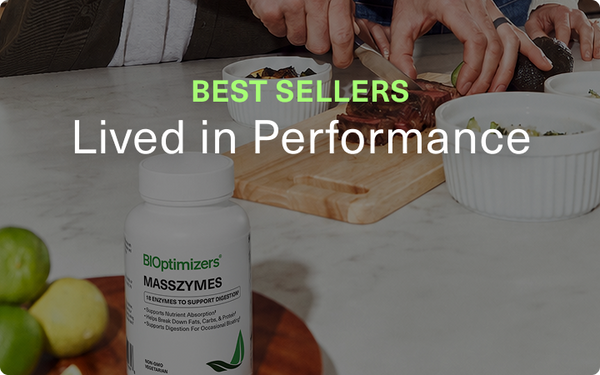

BEST FULL-SPECTRUM DIGESTIVE ENZYMES
MASSZYMES

MassZymes are full-spectrum plant-based digestive enzymes that enhance nutrient absorption and smooth digestion. Here’s why MassZymes are more effective than any other digestive enzyme products on the market:
- 3X your protein absorption
- Contains digestive enzymes that are active at all pH levels throughout the digestive tract
- Plant-based formula suitable for dietary restrictions and sensitivities to animal products
- Unique protease/peptidase blend that enhances protein digestion and absorption
- Includes plant-based enzymes such as cellulase, hemicellulase, and pectinase that break down the cell walls of plants that often cause gas and bloating
- It includes phytase, a unique enzyme that breaks down phytic acid, enhancing mineral availability from plant-based foods
- Works with a gut-healing protocol alongside other supplements such as Probiotic Breakthrough and HCl Breakthrough
- Very high potency of digestive enzymes, especially 100,000 units of proteases per capsule. This helps to maximize amino acid bioavailability.
- Delivers both digestive and systemic (whole-body) benefits with high doses of plant-based systemic enzymes like bromelain and serrapeptase
HOW PLANT-BASED FULL-SPECTRUM DIGESTIVE ENZYMES SUPERCHARGE MASSZYMES

Optimal Digestion, Even in Suboptimal Gut pH
Naturally, in a perfectly healthy gut, the stomach is very acidic, pH of 1 - 2.5. The acidity triggers bile and bicarbonate secretion, increasing the small intestine pH to 6 - 7.5 [1]. These pH (acid and alkaline levels) are crucial for optimal functions of digestive enzymes in the stomach and small intestine.
If you have suboptimal digestion or food-related digestive discomfort, you likely have low stomach acid and possibly suboptimal digestive enzyme production. Also, if you’re feasting on a huge meal, your stomach and overall gut could struggle to catch up. This means you’ll temporarily have low stomach acid and enzymes, which explains why eating a lot makes you feel stuffed. Your gut pH could be between 3 and 6.
Low stomach acid and enzymes have ripple effects throughout the digestive system, such as reducing bile and bicarbonate secretion into the small intestine and reducing the overall efficiency of your natural digestive enzymes. It can also reduce the activation of pepsin and other acid-dependent enzymes in your stomach.
Full-spectrum digestive enzymes means two things: that it contains enzymes that are active across all possible gut pH and that it has a comprehensive blend of enzymes.
Most animal-based digestive enzymes, such as from pigs and cows, are similar to human digestive enzymes. They have a stomach that produces hydrochloric acid and a liver that produces bile like we humans do. As a result, their enzymes are active at either very acidic or mildly alkaline pH.
In contrast, many plant-based enzymes, which also include bacterial and fungal, can be active at the in-between pH levels. This is why these plant-based enzymes are more suitable for re-optimizing digestion if you’re a healthy person who struggles with occasional digestive issues related to low stomach acid or enzymes.
These microbial (bacterial and fungal) enzymes are called plant-based enzymes because they’re compliant with a plant-based or vegan diet, even though bacteria and fungi are microbes, not plants. Bacteria and fungi have many more diverse enzyme types than humans do, such as those working throughout various pH, temperature, and conditions.

More Functional Diversity to Digest Everything, Eliminating Food-Related Bloating
Many food items that contribute to digestive upsets are from plants, such as cellulose, pectin, hemicellulase, strange sugars, and various types of polysaccharides. These can cause digestive discomfort because humans (and animals) don’t have the enzymes to digest them.
MassZymes contain plants and microbial enzymes that can break these down, eliminating digestive discomfort and gas from these foods getting fermented by gas-producing gut bacteria. It also has lactase to help break down lactose.

Maximize Protein Digestion and Amino Acid Availability, Even From “Low-Quality” Plant Proteins
Plant-based proteins, such as legumes, can have a lot of lectins and other types of proteins that human enzymes cannot digest well. Some lectins can go through the human gut intact [2].
Lectins may be a problem for those with lectin sensitivity. However, even if you’re not sensitive, the low digestibility of these proteins means it’s harder for you to absorb these amino acids into your muscles. This is unrelated to the complete protein problem, so you cannot fix this by mixing legumes with grains.
If you rely on plant proteins for overall protein intake or for muscle growth, it’s crucial to add a plant-based digestive enzyme. A clinical trial in 11 resistance-trained male subjects compared whey protein concentrate, pea and rice protein 70:30 blend with and without a plant-based digestive enzyme blend. While whey protein concentrate raised blood amino acid the best, the digestive enzymes reduced the difference between the pea/rice protein and whey protein concentrate [3].

Suitable for All Diets
Plant-based enzymes are more suitable for individuals with dietary restrictions or sensitivities, such as vegetarians and vegans, as they are from plant sources and do not contain animal products.

Are Plant-Based and Microbial Digestive Enzymes in MassZymes Safe?
For thousands of years, humans have been fermenting various foods with natural bacteria and fungi like Aspergillus. These microbes produce enzymes that help break down foods, such as tenderizing or improving the flavor of the foods. Even your gut bacteria produce digestive enzymes, many of which you cannot produce yourself.
Most enzymes in MassZymes come from these microbial sources, with a few from fruits like pineapple. They’re all Generally Recognized As Safe dietary ingredients according to the FDA due to long history of use. Moreover, our production and ingredient testing ensures that each batch has pure and safe enzymes, without any potentially harmful fungal or microbial toxins.
If you have severe allergic reactions or sensitivity to any ingredient or source of the enzymes in MassZymes, however, it’s best to avoid this product. As always, it’s best to consult a healthcare professional before introducing a supplement, especially if you have any medical condition.
MASSZYMES VS COMPETITORS PROTEOLYTIC ACTIVITY COMPARISON
To compare the protein digestion effectiveness, we compared the effect of our MassZymes blends with competitor products in the simulated stomach (pH 3.0) and small intestine (pH 7.5) conditions.
The released amino acids were measured with tyrosine liberation assay, whereas the remainder of the water-soluble proteins were measured with the Biuret test.
Each enzyme product was incubated with the substrate (whey or bovine serum albumin) at 37oC. For each product, one dose according to the product label was used in the experiment. Sub-samples were then collected at 30 minutes, 45 minutes, and 60 minutes. Upon sample collection, the digestion was immediately stopped by storing the samples at -20oC. Subsequently, each sample was tested for free tyrosine (an indicator of free amino acids) and remaining proteins with the Biuret test on the same sample.


Figure 1: Relative measures of protease activity per serving of each enzyme product, as measured with the tyrosine liberation assay. The Y-axis unit is presented in enzyme unit/mL. Error bars = 1 SD.
Conclusion:
Based on the ANOVA test on tyrosine liberation assay, MassZymes 4.0 was significantly more active than MassZymes 3.0 at pH 7.5. MassZymes 4.0 was marginally more active than MassZymes 3.0 at pH 3.0. Both versions of MassZymes were also significantly more effective than 5 popular competitor digestive enzymes on the market.


Figure 2: Relative measures of undigested protein upon incubation with a serving of each enzyme product, as measured by Biuret assay. The Y-axis unit is presented in mg/dL. Error bars = 1 SD.
Conclusion:
MassZymes 4.0 broke down whey protein significantly faster than MassZymes 3.0. MassZymes 4.0 completely broke down whey protein within 60 minutes at pH 3.0.
MassZymes 4.0 broke down BSA marginally faster than MassZymes 3.0.
Serving to serving, MassZymes 3.0 and 4.0 were superior to all popular competitor products at pH 3.0 and 7.5.competitor digestive enzymes on the market.
HOW EACH COMPONENT OF MASSZYMES WORKS SYNERGISTICALLY TOGETHER FOR SMOOTH DIGESTION

1. Protease/Peptidase Blend to Expand the Protein Absorption Ceiling
Not all proteases are created equal. In fact, each protease targets and only breaks apart specific patterns in your protein chain. For example, trypsin cuts next to lysine and arginine, whereas pepsin cuts before tyrosine, phenylalanine, and tryptophan. Peptidases cut peptides (small snippets of proteins) into amino acids for absorption.
This is also why plant proteins tend to be harder to digest than animal proteins, because they have amino acid sequences and structures that are less recognized by our own enzymes.
Therefore, you want to take a digestive enzyme supplement with diverse proteases and peptidases to optimize protein digestion and amino acid absorption [4].
Our BioLab uses the InfoGest system to optimize our plant-based protease blend for maximal effectiveness [5].
In an open-label clinical trial, healthy male participants consumed up to 50 grams of whey protein alone, or with 2.5 or 5 grams of fungal enzymes. Based on the way the gut works, the study estimates that it could only absorb about 15 grams of whey protein from a drink, as liquid quickly passes through the gut. The study found that from 1 hour after drinking the protein, the enzyme group had significantly higher amino acids in their blood. At 4 hours after consumption, the amino acid levels in the enzyme group reached 3.5-fold that of the control group.
In conclusion, digestive enzymes containing a protease and peptidase blend can significantly improve protein digestion and absorption from various sources [6].

2. Systemic Proteolytic Enzymes for Training Recovery Benefits
MassZymes contain systemic plant enzymes that can get absorbed into the bloodstream to deliver health benefits beyond the gut, when taken on an empty stomach. These include faster exercise recovery and clearing certain cellular debris [7].
Bromelain is a potent mix of proteases found in pineapple and the stem. Bromelain maintains its enzymatic properties until the intestines without significant side effects [8].
Serratiopeptidase is a potent digestive enzyme produced by a bacterium. This enzyme can break down proteins into amino acids.

3. Polysaccharides and Sugar-Digesting Enzyme Blends to Banish the Bloat
Carbs are delicious and crucial fuels for your muscles, brain, and everything. Yet, sometimes carb-containing foods can come with strange polysaccharides or sugars that are harder to digest and tend to cause bloating or discomfort. MassZymes contains one of the most comprehensive anti-bloat enzyme blends to help break down all of these components.
Fungal amylase from a fungal source helps break down starches [9].
Alpha-galactosidase breaks down complex carbohydrates (galactooligosaccharides) found in legumes, beans, grains, and cruciferous vegetables. These carbohydrates are commonly hard to digest and produce gas and bloating.
Glucoamylase optimizes the absorption of carbohydrates from sources such as corn, rice, wheat, and potatoes. The breakdown of these carbohydrates releases glucose for energy use.
Lactase helps digest lactose, found in dairy products such as milk and cheese. Lactose is a common culprit for gas and bloating in individuals who struggle to digest it without enzyme support.
Invertase converts table sugar (sucrose) into fructose and glucose for energy and easy absorption.
Pectinase ,hemicellulase, and cellulase break down plant cell wall components pectin, cellulose, and hemicellulose, respectively. This group of plant-based enzymes works synergistically to break down the cell walls of plants so that they can be easily digestible. They are typically found naturally in fungi, yeast, bacteria, and many plants [10]. Some people have gut bacteria that ferment these polysaccharides, leading to gas or stomach discomfort.
Beta glucanase optimizes the breakdown of beta-glucans, a group of soluble fibers typically found in cereals, mushrooms, yeasts, and seaweed cell walls. Beta-glucans are prebiotics beneficial for the gut flora, but when taken in excess, they can cause digestive concerns such as gas and bloating.
Phytase breaks phytic acid found in plant-based foods. Phytic acid can inhibit some enzymes and bind up minerals, rendering them unavailable to you. Breaking phytic acid can increase mineral availability and absorption [11].

4. Comprehensive Full-Spectrum Lipase Blend
Suboptimal fat digestion and rich, high-fat meals are common sources of digestive discomfort, especially at suboptimal gut pH and bile flow.
MassZymes contain a diverse combination of fungal lipases that can break down fats and oils across all pH ranges in the gut [12].
Overall, the combination of enzymes found in MassZymes work synergistically to enhance the digestion of proteins, fats, and carbohydrates and the absorption of nutrients.
MASSZYMES EFFECTIVELY BREAKS DOWN GLYPHOSATE INTO HARMLESS METABOLITES
To test if MassZymes can break down glyphosate, we incubated MassZymes dissolved in water with 500 parts per million (ppm) of glyphosate and incubated at 37 degrees for 2 hours. The released products were quantified using ninhydrin and tyrosine liberation assays. In addition, we used thin layer chromatography (TLC) and high-performance liquid chromatography (HPLC) to test for glyphosate and their metabolites.
After 2 hours of incubation, glyphosate was undetectable in samples 3 - 7. These chromatography assays had the detection limit of 0.3 ppm. Therefore, based on chromatography assays, MassZymes broke down the 500 ppm of glyphosate down to less than 0.3 ppm. The byproducts of this glyphosate breakdown are glyoxylic acid, sarcosine, and aminomethylphosphonic acid (AMPA). Although the evidence is unclear on whether AMPA has some toxicity, it seems to have less effect on the gut microbiota than glyphosate.[13]
HOW TO USE MASSZYMES
In the absence of other contraindications, MassZymes is safe to take multiple times a day, with or in between meals [13].
The best MassZymes protocol varies depending on your health goals.

Gain Weight or Muscle Gain
Weight gain requires a caloric surplus. Muscle gain also requires a hypertrophy training program and a high-protein diet. MassZymes can help maximize protein digestion, amino acid absorption, and exercise recovery.
For every 600-calorie meal, take 3 capsules of MassZymes.
MassZymes can also be taken with or mixed into pre or post-workout protein shakes to maximize amino acid bioavailability and muscle protein synthesis.

Counteracting Age-Related Sarcopenia and Amino Acid Deficiencies
Take 3 capsules of MassZymes and 2 capsules of HCl Breakthrough with every meal, especially protein-containing meals.

Overcome Occasional Food-Related Digestive Symptoms
Start with 3 - 5 capsules of MassZymes and take more as needed for digestive comfort.

Gut Protocols
Take 3 - 5 capsules of MassZymes with 2 capsules of P3OM and 1 - 2 capsules of HCl Breakthrough with each meal
3 - 10 capsules, as tolerated, can also be taken in between meals for systemic benefits.

Relieving Occasional Discomfort From Occasional Overeating (Buffet, Thanksgiving, Etc.)
7 - 10 capsules of MassZymes, 2 capsules of P3OM, and 2 capsules of HCl Breakthrough.
SIDE EFFECTS AND CONTRAINDICATIONS OF MASSZYMES
Always consult your doctor or pharmacist before making changes in your diet and supplement regimen, especially if you’re receiving any medical treatments. Do not take MassZymes if you have the following:
- Blood thinners or medical treatments that affect blood clotting ability
- Stomach or intestinal ulcers
HOW TO SUPPORT DIGESTION AND IMPROVE YOUR NUTRIENT ABSORPTION
Although we would love to tell you otherwise, there is no quick fix for improving your digestive system. Optimal digestion and nutrient absorption require a combination of dietary, lifestyle, and supplemental adjustments when needed.
Some tips for optimal digestion include:
- Eating slowly and mindfully, chewing food thoroughly
- Managing stress and practicing stress-reducing techniques during meals can aid in proper digestion and nutrient assimilation [14]
- Consuming a balanced and nutritious diet that contains vitamins, minerals, plant-based antioxidants, and essential fatty acids
- Eat the rainbow! Include different colored vegetables in your diet, which promote prebiotic compounds that can optimize a healthy gut flora [15].
- Incorporating sources of dietary fiber, such as fruits, vegetables, nuts, whole grains, and legumes, to feed the gut flora
- Consuming fermented foods, such as yogurt, kefir, and sauerkraut, can introduce beneficial probiotics to the gut, promoting a healthy gut microbiota and supporting nutrient absorption [16].
- Drinking plenty of water throughout the day can ensure adequate hydration, facilitate the transport of nutrients, and promote optimal digestion
- Consuming foods rich in digestive enzymes, such as pineapple and papaya, can promote the breakdown of nutrients
- Consuming digestive bitters before a meal stimulates the digestive system to produce gastric juices and enzymes to prepare for food breakdown
- Avoid chewing gum and drinking straws as they allow air to enter the digestive system, leading to gas and bloating
- Consider using probiotics and digestive enzymes, such as MassZymes or HCL Breakthrough, to support overall digestive health and nutrient absorption
Even with perfect diets, most healthy people struggle with suboptimal digestion due to poor eating hygiene–they eat too fast, distracted, in a hurry, or while stressed. As a result, the stomach and intestine don’t release optimal amounts of digestive juices and enzymes. This is when digestive enzymes and other digestive support can be very beneficial.

Symptoms of Suboptimal Digestion
- Occasional post-meal bloating and gas
- Undigested food or mucus in your stool
- Irregularity
- Feeling overly full after eating
- Nutrient deficiencies despite consuming or supplementing with nutrients
- Suboptimal immune functions
- Dull or suboptimal skin health
- Afternoon or post-meal fatigue
- Accelerated aging
It's important to note that individual experiences may vary, and persistent or severe symptoms should be discussed with a healthcare professional for proper evaluation and guidance.
Frequently Asked Questions:
Also Consider

Our powerful L. plantarum strain that secrete proteases and postbiotics that promote a healthy gut flora.

Betaine HCl along with digestive enzyme blend to optimize stomach digestion.

Powerful Peptidase DPP IV blend to fully break down gluten and occasional indulgent high-carbohydrate meals.

Maximize your ketogenic diet with a high lipase and mitochondria-boosting blend.
REFERENCES
- Evans DF, Pye G, Bramley R, Clark AG, Dyson TJ, Hardcastle JD. Measurement of gastrointestinal pH profiles in normal ambulant human subjects. Gut. 1988 Aug;29(8):1035-41. doi: 10.1136/gut.29.8.1035. PMID: 3410329; PMCID: PMC1433896.
- Adamcová A, Laursen KH, Ballin NZ. Lectin Activity in Commonly Consumed Plant-Based Foods: Calling for Method Harmonization and Risk Assessment. Foods. 2021 Nov 13;10(11):2796. doi: 10.3390/foods10112796. PMID: 34829077; PMCID: PMC8618113.
- Minevich J, Olson MA, Mannion JP, Boublik JH, McPherson JO, Lowery RP, Shields K, Sharp M, De Souza EO, Wilson JM, Purpura M, Jäger R. Digestive enzymes reduce quality differences between plant and animal proteins: a double-blind crossover study. J Int Soc Sports Nutr. 2015 Sep 21;12(Suppl 1):P26. doi: 10.1186/1550-2783-12-S1-P26. PMCID: PMC4595032.
- Minevich J, Olson MA, Mannion JP, Boublik JH, McPherson JO, Lowery RP, Shields K, Sharp M, De Souza EO, Wilson JM, Purpura M, Jäger R. Digestive enzymes reduce quality differences between plant and animal proteins: a double-blind crossover study. J Int Soc Sports Nutr. 2015 Sep 21;12(Suppl 1):P26. doi: 10.1186/1550-2783-12-S1-P26. PMCID: PMC4595032.
- Valentina Azzurra Papillo, et al. “In Vitro Evaluation of Gastro-Intestinal Digestion and Colonic Biotransformation of Curcuminoids Considering Different Formulations and Food Matrices.” Journal of Functional Foods, vol. 59, 1 Aug. 2019, pp. 156–163, https://doi.org/10.1016/j.jff.2019.05.031. Accessed 16 July 2024.
- Oben J, Kothari SC, Anderson ML. An open label study to determine the effects of an oral proteolytic enzyme system on whey protein concentrate metabolism in healthy males. J Int Soc Sports Nutr. 2008 Jul 24;5:10. doi: 10.1186/1550-2783-5-10. PMID: 18652668; PMCID: PMC2500001.
- Shing CM, Chong S, Driller MW, Fell JW. Acute protease supplementation effects on muscle damage and recovery across consecutive days of cycle racing. Eur J Sport Sci. 2016;16(2):206-12. doi: 10.1080/17461391.2014.1001878. Epub 2015 Jan 21. PMID: 25604346.
- Pavan R, Jain S, Shraddha, Kumar A. Properties and therapeutic application of bromelain: a review. Biotechnol Res Int. 2012;2012:976203. doi: 10.1155/2012/976203. Epub 2012 Dec 10. PMID: 23304525; PMCID: PMC3529416.
- Saranraj, P, and D Stella. “Fungal Amylase -A Review.” International Journal of Microbiological Research, vol. 4, no. 2, 2013, pp. 203–211, pdfs.semanticscholar.org/2c80/1f8651e5e645e315f066d1122798cff67dc7.pdf, https://doi.org/10.5829/idosi.ijmr.2013.4.2.75170.
- de Souza, Thaiza S. P., and Haroldo Yukio Kawaguti. “Cellulases, Hemicellulases, and Pectinases: Applications in the Food and Beverage Industry.” Food and Bioprocess Technology, vol. 14, no. 8, 21 June 2021, pp. 1446–1477, https://doi.org/10.1007/s11947-021-02678-z.
- Joudaki H, Aria N, Moravej R, Rezaei Yazdi M, Emami-Karvani Z, Hamblin MR. Microbial Phytases: Properties and Applications in the Food Industry. Curr Microbiol. 2023 Oct 17;80(12):374. doi: 10.1007/s00284-023-03471-1. PMID: 37847302; PMCID: PMC10581959.
- Mehta, Akshita, et al. “Fungal Lipases: A Review.” 2017.
- Minich DM. A Review of the Science of Colorful, Plant-Based Food and Practical Strategies for "Eating the Rainbow". J Nutr Metab. 2019 Jun 2;2019:2125070. doi: 10.1155/2019/2125070. Erratum in: J Nutr Metab. 2020 Nov 28;2020:5631762. doi: 10.1155/2020/5631762. PMID: 33414957; PMCID: PMC7770496.
- Cherpak CE. Mindful Eating: A Review Of How The Stress-Digestion-Mindfulness Triad May Modulate And Improve Gastrointestinal And Digestive Function. Integr Med (Encinitas). 2019 Aug;18(4):48-53. PMID: 32549835; PMCID: PMC7219460.
- Minich DM. A Review of the Science of Colorful, Plant-Based Food and Practical Strategies for "Eating the Rainbow". J Nutr Metab. 2019 Jun 2;2019:2125070. doi: 10.1155/2019/2125070. Erratum in: J Nutr Metab. 2020 Nov 28;2020:5631762. doi: 10.1155/2020/5631762. PMID: 33414957; PMCID: PMC7770496.
- Leeuwendaal NK, Stanton C, O'Toole PW, Beresford TP. Fermented Foods, Health and the Gut Microbiome. Nutrients. 2022 Apr 6;14(7):1527. doi: 10.3390/nu14071527. PMID: 35406140; PMCID: PMC9003261.